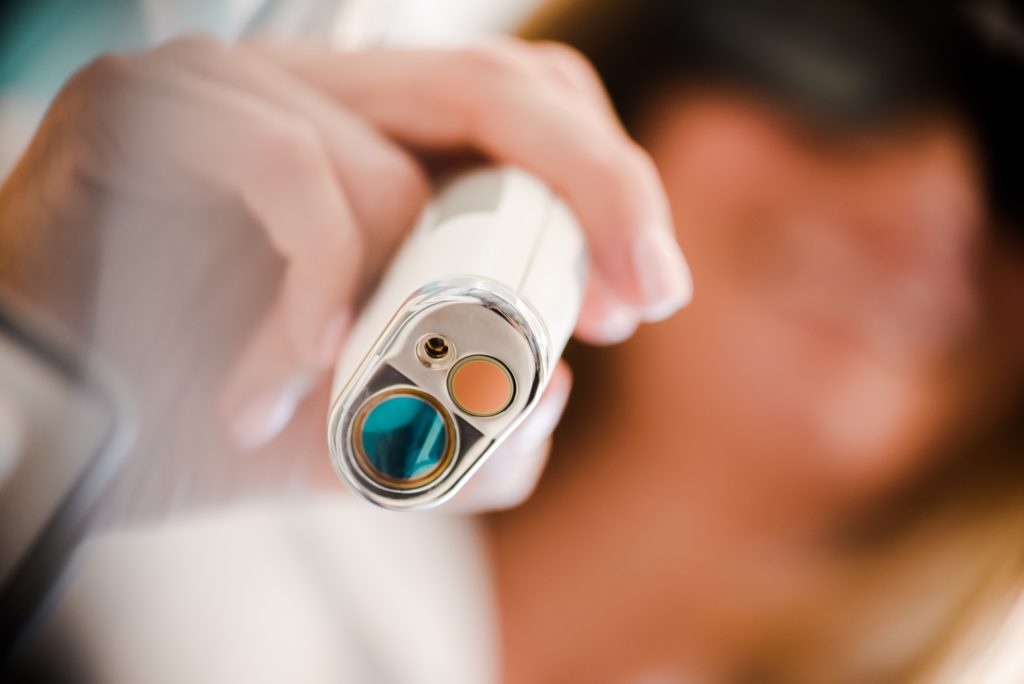
Personalised treatment for keloids and thickened, cosmetically unsightly scars – using a combination of injection, laser and light-based treatments
The appearance of scars depends on the nature and location of the injury or operation, as well as on an individual’s tendency to heal. Some scars fade and flatten over time, whilst others may thicken, become raised, turn red, or cause itching or tightness.
I always choose the method of scar treatment based on the type, age, colour, thickness and location of the scar. The best results are often achieved by combining several different treatment methods.
Hypertrophic scar: A raised, thickened, often red scar that remains within the boundaries of the original wound. It may flatten spontaneously over time, but this process can be facilitated with appropriate treatment.
Keloid: abnormal scar tissue that extends beyond the boundaries of the original wound, which does not usually recede on its own and is prone to recurrence. Individual and genetic predisposition also play a role in its development.
Treatment of thickened and keloid scars
One of the most commonly used methods for treating raised scars is the injection of corticosteroids into the scar tissue. The aim is to reduce the formation of abnormal scar tissue, gradually flatten and soften the scar, and alleviate itching and tightness.
The treatment usually requires several sessions; I adjust the number and frequency of the injections according to the condition of the scar and the patient’s response to the treatment
Laser and light-based treatments
Injection treatment may be used, where necessary, to improve the colour, vascularity and texture of the scar With BBL®, ClearV® or ClearSilk® treatment I’ll add to that.
BBL® – primarily to reduce redness and discolouration of the scar
ClearV® – for the targeted treatment of more visible dilated blood vessels within a scar
ClearSilk® – for improving the overall quality and texture of the skin and scars
By combining different treatments, it is possible to reduce not only the thickness of the scar, but also its colour, grain and surface appearance can also be repaired.
When is the best time to start treating a scar?
In many cases, scar treatment can begin at an early stage. A fresh scar that is still actively remodelling is generally more responsive to treatment than older, mature scar tissue.
If you are prone to keloids or hypertrophic scarring, it is particularly important to monitor how the scar develops following surgery or an injury, and to consult a dermatologist in good time should you notice any thickening, increasing redness, itching or enlargement.
The use of silicone gel or silicone sheets, as well as consistent sun protection, can be an important part of scar treatment.
Personalised treatment plan
No two scars are the same, which is why the appropriate treatment is always preceded by a dermatological examination. The aim of the treatment is to gradually flatten and soften the scar, and to improve its colour and texture, thereby making it less noticeable.
It is not usually possible to make scars disappear completely; however, with carefully chosen treatments – combined where necessary – their appearance can be significantly improved.
In the case of keloids, it is important to bear in mind the possibility of recurrence; therefore, we monitor the results of treatment regularly and carry out further treatment if necessary.