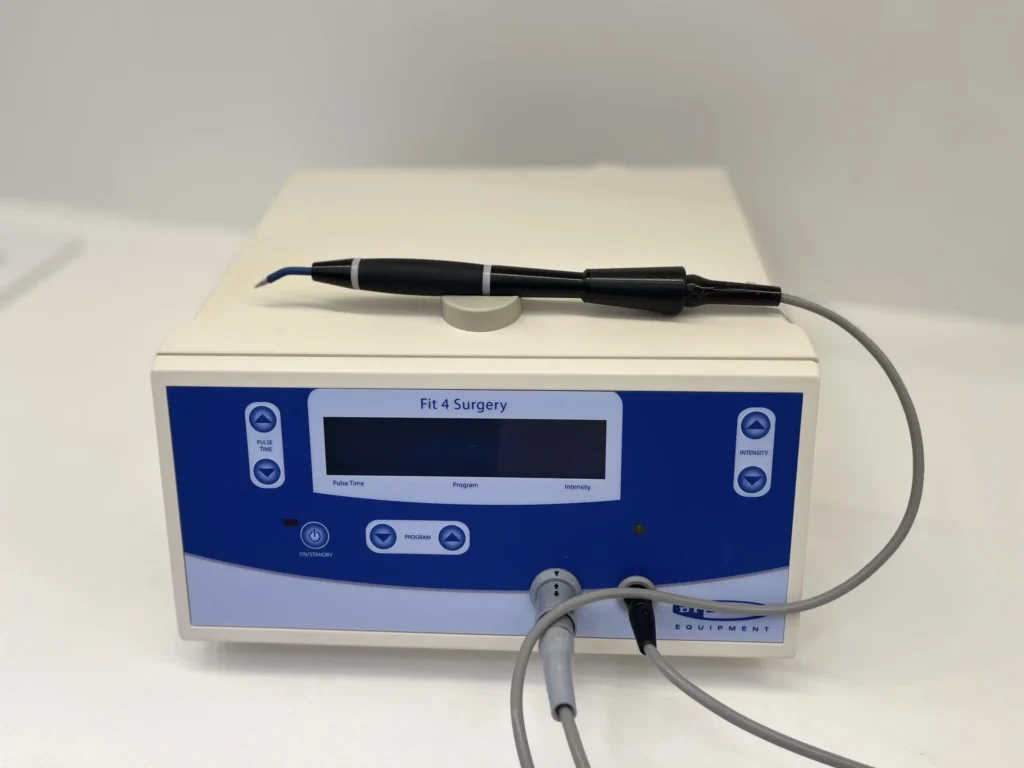
Removal of benign skin growths using radiofrequency electrocautery
For the precise removal of fibromas, seborrhoeic keratoses and other benign skin growths
A number of benign growths may appear on the skin over the course of a person’s life. These are generally harmless from a medical point of view, but they can be cosmetically unsightly and, depending on their location, may become irritated or damaged. I remove benign skin growths using radiofrequency electrocautery.
The device’s fine electrode uses radio-frequency energy to generate a targeted thermal effect in the tissue being treated, allowing the benign skin growth to be removed precisely, layer by layer, whilst sparing the surrounding healthy skin.
Fibromas (fibroma pendulans): growths, which are primarily found on the neck, in the armpits and in skin folds; they may be pedunculated or flat, soft, and skin-coloured or light brown.
Seborrhoeic keratoses: skin lesions that protrude from the skin, often with a rough surface, and are skin-coloured, light brown or even dark brown in colour.
Sebaceous hyperplasia: small, yellowish or skin-coloured lesions that appear mainly on the face.
Milia: tiny, white, superficial keratin cysts.
Certain warts: benign skin growths of viral origin.
Information about the treatment
How does the treatment work?
Before the treatment, I examine the skin lesions to be removed using a dermatoscope. If necessary, I administer a local anaesthetic via injection. I then remove the skin lesion using radiofrequency electrocautery. The duration of the treatment depends primarily on the number and size of the lesions to be treated.
What can you expect after the treatment?
A small wound forms at the treatment site, followed by a scab, which usually falls off on its own within 1–2 weeks. The duration of healing depends on the size, depth and location of the lesion removed. In most cases, the skin heals without leaving a mark after the removal of small growths or fibromas. In the case of larger lesions, the skin may temporarily appear lighter in the treated area. In most cases, this difference in colour gradually evens out over a period of weeks or months. A faint mark may remain permanently – however, this is far less noticeable than the raised lesion that was removed. The quality of healing is also influenced by the individual’s tendency to heal wounds.
Once the skin has fully peeled, it is particularly important to ensure adequate protection from the sun, especially in areas exposed to sunlight, as this reduces the likelihood of post-treatment pigmentation.
Can a removed skin growth grow back?
The removed lesion does not usually recur; however, in patients who are prone to them, new, similar benign skin growths may appear in other areas over time.